GLD USD
Last:428.32
 -2.68
-2.68
Gold going up this year?
 Post Reply
661-680 of 1037
Post Reply
661-680 of 1037
what happen???
My guess is gold will kiss 920 again before it correct into end sept to 760 to 800..DYODD.
andd then on to 1300 to 1400..maybe overshoot to 1500...
I think gold may go lower come summer...this is due to stock rally till end summer...i am expecting a dow of 10000...the least is 9500..
This David Nicholas is not that accurate...i have been following for quite sometimes...the most accurate to date for me is still Martin Weiss..he was calling the crash at end of 1st quater 2007...anothor is Claus Vogt...try follow them and see for yourself...every one got their own judgement..DYODD..
The best speculative opportunity since technology stocks in the early 1990s!
|
 |

For every generation, there is one investment theme which captures the public's imagination, driving a frenzy of speculation and price gains beyond reason for anybody early to the trend.
In the early 1990s, technology stocks and the internet fueled a Nasdaq boom beyond anybody's wildest dreams.
|
| The most salient characteristic of these booms is the parabolic price chart, as larger and larger amounts of money pouring into a market causes prices to rapidly climb an astonishing growth curve. |
|
 |
|

The next great parabolic price chart is gold, and it is still very early on the growth curve.
A common mistake is to think that you've missed out on the move up, as prices have already moved up significantly off the absolute bottom. But when an investment theme is so simple to understand, and has such compelling logic behind it, then there is no upper limit on how high prices can go.
The most important investment theme for the next 10 years will continue to be the frenzy for tangible, hard assets, in response to a global economy oversaturated with paper currencies.
And the best market to take advantage of this trend is gold!
My name is David Nichols, and I've spent the last 10 years developing a new way of looking at financial markets, which I call Fractal Market Analysis. My proprietary techniques go far beyond technical and fundamental analysis, revealing the order hidden within seemingly random financial markets.
One of the most exciting things I've discovered is the predictability of parabolic price moves. It's counter-intuitive, but the more speculative a market, the more closely it follows its ideal fractal path, making parabolic markets ideal for aggressive speculation, especially in the later stages.
Gold is the most exciting speculative opportunity of the next 10 years, making this a market journey that you do not want to miss. The truth is you can't afford to miss the ride up in gold, as the dollars you are earning and saving will continue to erode in value at an astonishing pace as gold continues to rocket higher.
I encourage you to check out this free Special Report on gold, and to also sign up for a trial subscription to the Fractal Gold Report, a daily service for active traders and long-term investors.
Warm regards,
David Nichols, Editor
Fractal Gold Report |
Germany have 64.4% of their reserve in gold and co-incidentally it went thro a hyperinflation in 1939..
Why such hugh reseve in gold, because they experience hyperinflation...a hard lesson learned...they keep large rserve in gold ..this show they are serious not to let it happen again by having hugh reseve in gold.
http://www.321gold.com/editorials/russell/russell021909.html
Almost two years ago, Alexander Green showed us six reasons why we should be
investing in gold. Five of those are as true today as they were then.
- The U.S. dollar is weakening. That makes the
precious metal, typically denominated in dollars, cheaper to buy in
other currencies. (Euro-denominated investors think gold still looks
cheap.) Gold traditionally rallies as the dollar falls.
- Inflation fears. Only a few months ago, Bernanke
was openly fretting about the possibility of higher inflation - and
saying the Fed’s bias was toward tightening rates. Yet he has cut rates
dramatically to lessen the credit crunch resulting from a meltdown in
mortgage-based securities. Needless to say, the Fed’s action was
inflationary. And gold is an excellent inflation hedge.
- Emergence of China and India. A flourishing middle
class in both emerging giants is increasing the demand for gold.
(Jewelry fabrication was up more than 50% in India alone last year.)
People everywhere want gold watches, gold coins and gold wedding bands.
- Supply constraints. Around the world, discovery
rates are falling. Mines are being depleted and mining companies are
producing lower grade base metals.
- Geopolitical instability. There are plenty of
hotspots around the world today. But gold is viewed as a safe haven
during times of political or economic calamity.
And while we’ve seen some slowdown in
BRIC nations
China and India, it’s worth pointing out that little else has changed
since. But most of this is old news. We’ve known about these factors
for quite some time.
It’s why I’ve saved the best for last.
Gold Mining Stocks & Gold Prices
It’s no secret that
gold mining stocks rise and fall with the performance of gold. The market is pricing in the future profit potential of these companies.
It’s not uncommon to see a gold producer stock plummet in price
after a significant price plunge. However, what many don’t realize is
that these fluctuations have less bearing on the profit potential than
you would think…
Here’s the secret.
Gold has to come down a long way to make producers unprofitable!
The cost of producing gold is about $317 an ounce. The price of gold
as I write this is just under $890. That’s a profit margin of around
$573 for companies with active mines - about 180% of their costs. Even
if gold plummets to $700 an ounce, these companies are still making
120% of their costs.
That’s a subtle difference between profitable and really profitable
- and it’s also a huge moat of safety for these companies pumping what
really glitters onto the open market.
Of course there’s another way to play gold mining stocks. Though
there’s more risk investing in mining companies already producing gold,
it can be much more rewarding.
4 Gold Mining Stocks For A Well Diversified Portfolio
At the
Investment U Conference, I was talking with
commodities and resources expert Rick Rule who offered a fascinating
play on gold mining stocks that aren’t the usual mining equities. These
unique companies are called prospect generators.
Imagine how powerful it would be to have a group of highly trained
experts out prospecting for your very own new gold or resources
discovery. Imagine having the best geologists and mining engineers on
your “
A” team, out in the field prospecting for you.
If your crack team hits a big strike, the company share price could
unexpectedly shoot up 100% to 1,000% - in a few weeks. These are
exactly the situations that Rick uses to get returns of up to $1,000
for each dollar he puts in the deal.
Rick goes out and purchases a few of these “prospect generators,”
then he sits back and waits. When a prospect generator has hit pay dirt
in the past, Rick has suddenly had a cash gusher on his hands.
If you’re looking for gold mining stock prospect generators, take a look at:
- Esperanza Silver Corporation (CVE: EPZ),
- Riverside Resources Inc. (CVE: RRI),
- Almaden Minerals Ltd. (NYSE: AAU)
- And Cornerstone Capital Resources (CVE: CGP).
All have the potential to be your next cash gusher.
It all starts with education,
Dr. Scott Brown
www.investmentu.com
T.A for gold is good for entry now..for those short term players..
DYODD
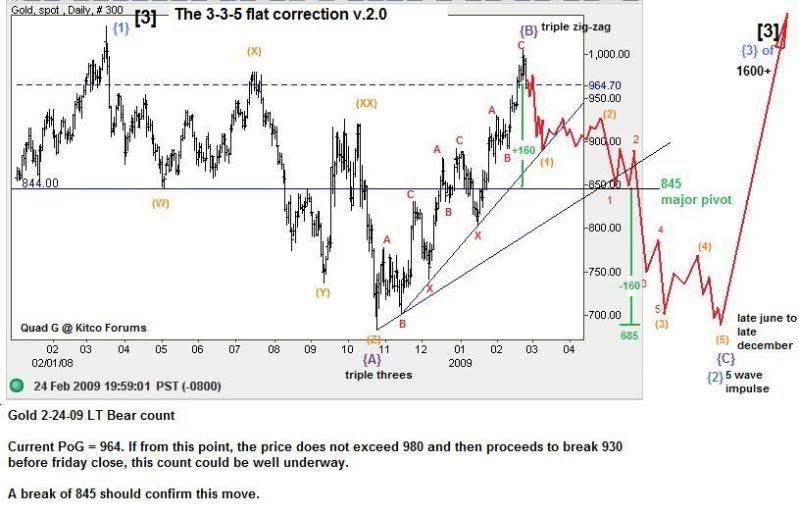
Wave count is very subjecive & complex, it is more of an art than science depending on how each individual analyse the count, thus true wave analysis practitioner always have an alternative wave count but here where is the alternative wave count??.
Take a look at this, looks more professional as he offers an alternative wave count.
(1) Long term less bullish wave count but long term bullish:
http://stockcharts.com/def/servlet/Favorites.CServlet?obj=ID369857&cmd=show[s161474176]&disp=P
(2) Long Term Bullish wave count
http://stockcharts.com/def/servlet/Favorites.CServlet?obj=ID369857&cmd=show[s161471755]&disp=P
cheongwee ( Date: 08-Apr-2009 18:25) Posted:
GOLD IS NOT READY YET..
 |
|
GOLD IS NOT READY YET..
Gold is heading up again...but will be down for me in summer. I can see it ...Growing big time late 09
time to accumulate GOLD as the market tanks! DYODD!
Multiple support for gold around the 850 level - Buy level
Quote:
"list I see multiple support for gold around the 850 level. This is the kind of support where you want to start buying"
don't see the present...look to the future..
OMG!!!....OH MY GOLD
 I am finish...what hyperinflation???..stock going up...Obamamania is working fine..everyone is toking abt stock now...gold is relic...history...done.
time to accumulate gold on the dip...
hyperinflation coming ur way..don't let it eat away ur CA$H
read this and feel comfortable with gold and silver...
cna you change the rule to change your future or turn your losses into profit..
if they can...pig will fly.
|
|
|
|
|
|
|
|
|
|
|
|
|
| YOUR BEST SOURCE FOR THE UNBIASED MARKET COMMENTARY YOU WON'T GET FROM WALL STREET |
|
|
|
Mark to Market Madness ... Geithner Plan Shenanigans ... the Economy ... and More
by Mike Larson
Dear Cheongwee,
I've had a lot on my mind this week, and so has the market. Mark to market accounting ... the Geithner plan ... and the latest economic data have all been capturing the attention of investors. So I want to share my latest thoughts on all of these market drivers, and explain where we're likely headed next ...
Mark to Market Accounting Mess Shows That
Congress, Bankers Just Don't Get It ...
This week, the Financial Accounting Standards Board (FASB) caved on the mark-to-market accounting front. Members of the board agreed to give financial institutions more flexibility in valuing assets, including the "toxic" ones that have given investors so much agita.
You could see this coming a mile away because Congress has essentially been browbeating the group into submission. Recent hearings and commentary from legislators made it clear that if FASB didn't kowtow to the banking lobby and amend mark-to-market standards, Congress would find a way to make it happen.
Where do I stand on this? I made my position abundantly clear on March 13, when I wrote the following in my Money and Markets column:
"Look, the problem isn't that there's NO market for these bad securities. The problem isn't that the prices are "artificially" low. The problem isn't how we account for these assets. The problem is that the industry doesn't want to acknowledge that today's prices are the REAL prices.
There are tons of bidders out there for this crappy paper ... at the RIGHT price. Vulture funds, hedge funds, private equity investors: They're all raising billions and billions of dollars to scoop up cheap real estate, inexpensive bundles of mortgage backed securities, and distressed buyout loans.
But sellers don't want to admit reality. They're not hitting the buyer's bids. They're hanging on to the garbage securities, hoping against hope that they won't have to sell at the true market prices. And the government is busy trying to figure out ways to prop up the price of the garbage rather than forcing banks to take their medicine now, even if it means the result is that they have to temporarily be nationalized or put into receivership."
Nothing has changed my opinion since then. The banking lobby argues that because many of these assets are still spinning off principal and interest payments, they should be able to carry them at full value or close to it — not the supposedly distressed, "false" market prices.
But look at the performance of the asset markets underlying the toxic paper! Those markets aren't getting better. They're getting worse.
The latest figures from S&P/Case-Shiller showed housing prices plunging 19 percent year-over-year in January. That was the biggest yearly drop on record. The monthly decline (2.8 percent) between December and January was the biggest ever seen. Every single market showed deteriorating prices. Heck, I've seen a few isolated examples of properties changing hands or being listed at prices they haven't seen in more than a decade — or two!
At the same time, FHA loan delinquency rates are rising. Fannie Mae and Freddie Mac 90+ day late payment rates are surging. The number of borrowers who are "upside down" — meaning they owe more on their mortgages than their homes are worth — continues to climb month after month.
All of this tells us that while some of these securities may be spinning off income NOW, the likelihood they will continue to do so in the FUTURE is going down. So while the comments that the banking lobby are making may be TECHNICALLY accurate, they certainly don't prove the "real" value of these securities should be much higher.
 |
| The John Hancock Tower was just sold on the auction block for 49.2 percent less than it went for three years ago. |
And it's not just residential real estate where the underlying assets are tanking. Take the John Hancock Tower in Boston. It's a prized piece of trophy real estate, the tallest building in New England, and it changed hands at $1.3 billion in 2006.
Well guess what? It was just re-sold in a foreclosure auction. The price? $660.6 million. Total decline in value? 49.2 percent in less than three years.
Meanwhile, according to The Wall Street Journal, delinquencies on commercial mortgages are soaring. The delinquency rate on $700 billion in securitized commercial real estate loans has more than doubled in just the past six months. At 1.8 percent, it's still low on an absolute basis. But it's the direction that counts, and analysts are now expecting delinquency rates to rival those seen in the early 1990s commercial real estate collapse.
So what does that say about the value of CMBS — Commercial Mortgage Backed Securities? You guessed it: The value of those securities SHOULD plunge. Yet industry lobbyists claim that it's not crappy fundamentals driving their value down, it's illiquidity — and that they shouldn't have to take big mark downs as a result. What a joke!
Geithner Plan Structured as a Blatant
Wall Street Giveaway ...
Let me ask you a question: Suppose you wanted to buy something that has an even chance of being worth nothing or $200 a year down the road. You might be willing to pay $100 for it, because you have a 50/50 chance of doubling your money.
Now say the government came along and said: "We're going to give you 92 bucks to buy this asset, and if you "win," we'll only take 50 percent of your profit. If you lose, we'll eat almost all of the costs."
Not a bad bargain, eh? You might even say it's a great one. And since you have so little money at stake (8 percent of the purchase price), you might even be willing to pay an inflated price for the asset — say, $150. In that case, you'd have to put up just $12, while the government would give you $12 in equity and a $126 guaranteed loan.
In a "win" scenario (where the asset goes to $200), you pay back the government's $126 loan and you split the $74 profit 50-50. Congratulations! You just made $37 on a $12 investment. Your partner, the government, who took on $138 in risk, also made $37 — but received a much smaller percentage return.
In a "lose" scenario, you take a $12 hit. But the government gets stuck with a loss of $138.
| Internal Sponsorship |
|
INVESTOR BEWARE:
Despite the smiles and happy talk at the G-20,
THE WORLD BANK and OECD just warned that ...
The global economy is falling off the cliff!
The World Bank and The Office of Economic Development (OECD) just warned that this year, global industrial output will fall for the first time since World War II — and you're still waiting for Washington to bail you out!
Join us for a national press briefing to learn the six steps you should be taking NOW to preserve your wealth.
Click here for details ...
|
| |
Talk about a sweetheart deal! And I'm not pulling these numbers out of thin air. They come directly from a damning New York Times op-ed piece by Joseph Stiglitz, a Nobel prize-winning economist and professor at Columbia University. He added:
"The Obama administration's $500 billion or more proposal to deal with America's ailing banks has been described by some in the financial markets as a win-win-win proposal. Actually, it is a win-win-lose proposal: The banks win, investors win — and taxpayers lose.
"Treasury hopes to get us out of the mess by replicating the flawed system that the private sector used to bring the world crashing down, with a proposal marked by overleveraging in the public sector, excessive complexity, poor incentives and a lack of transparency."
If you're not outraged that we're bailing out the banks in this fashion, you should be. Martin and I have advocated a much different approach, one we believe is both fairer and more effective. You can read about it in the white paper Martin recently presented in Washington, DC, to the National Press Club.
If we continue down this current path, we're going to look a heck of a lot like Japan in the 1990s. And we're far from the only ones to arrive at that conclusion. As Adam Posen, the deputy director of the Peterson Institute for International Economics, recently wrote:
"A number of major American banks have lost huge amounts of money, and clearly have insufficient capital if they are not literally insolvent. Why else would they be pushing so hard to change the accounting rules to avoid showing what they really have on their books instead of raising private capital? Why else is the U.S. government taking so long to perform "stress tests" and trying to get expectations of overpayment for some of the bad assets on the banks' books before the test results are out? In short, the U.S. government is looking to shovel capital into the banks without sufficient conditions, hiding rather than confronting the actual situation.
"That is just like the Japanese government in their lost decade, or the U.S. officials during the 1980s before they really tackled the savings-and-loan crisis. In those cases, the delay simply made the problem worse over time and in the end the government had to put more money into the troubled banks directly, taking over or shutting down the weakest of them."
The Latest on the Economy
I read and hear a lot of talk about how the economy has supposedly "bottomed" and how we're ready to be off to the races again. To which I say "Huh?"
While I may be the first to admit we've gone from "all terrible" news to "slightly less than terrible," I can't find any evidence of any kind of lasting, V-shaped recovery or even a dramatic turn.
Pending existing home sales? Sure they were up 2.1 percent in February. But that gain came after a 7.7 percent PLUNGE a month earlier. The sales index, at 82.1, was still at its second-lowest level on record.
 |
| Continuing jobless claims topped 5.72 million — the highest ever recorded in 42 years of record-keeping. |
The job market? An epic disaster according to the employment services firm ADP. The company said the economy shed a whopping 742,000 jobs last month, the biggest drop ever and much worse than economists were expecting. Initial jobless claims just climbed to 669,000, the highest since October 1982, while continuing jobless claims topped 5.72 million — the highest ever recorded in 42 years of record-keeping.
Consumer confidence? Yes, it was "up" in March. But by a lousy 0.7 points. The reading of 26 was worse than economists were expecting and the second-worst reading (after February) in the index's 42-year history.
Also worth noting: The percentages of survey respondents saying they planned to buy cars, homes and major appliances all dipped on the month. In fact, only 2 percent of those polled said they would buy a house, the lowest reading since October 1982 — when the average 30-year fixed mortgage went for 14.6 percent.
Where to from Here ...
Now that the big mark-to-market change is behind us, I believe a "sell the news" reaction is possible. I wouldn't be surprised one bit if the financial stocks gave up a sizable chunk of their recent gains. Changing the way you account for losses on bad assets doesn't mean the losses have gone away. If anything, the obfuscation of those losses will drive investors away because balance sheets in the financial sector will become more opaque.
I also believe that Geithner's bad asset plan is going to see more and more resistance in Congress and the court of public opinion. As the details get fleshed out more on the airwaves, the Internet, and the pages of The New York Times, more people are going to come to the same conclusion that I have: It's a blatant giveaway to hedge funds, mutual funds, and other financiers from U.S. taxpayers.
 |
| Protesters at the G-20 meeting in London give a clear sign that people aren't happy with what they see going on. |
Will people really stand for that?
They're already fed up with the industry — you need only look at the protests in the streets of London during the G-20 meeting to see that. So don't be surprised at all if this plan stalls out, and if financial stocks weaken as a result.
As for the economy, I wish I could be more optimistic. But I think anyone buying into the recent stock market rally on the assumption the economy is roaring back is going to be sorely disappointed. I'd stick with hedges like inverse ETFs, because I believe stock prices are not done going down.
Until next time,
Mike
|
|
“He who buys the dips and rides the waves will be a winner in the end.” Richard Russell.
Buy.....buy stock for max profit..i have been buying..to profit even more, buy silver...jmo...DYODD
never wrong...you never regret..
and buy the dip...the dip is coming..dont miss...just like this rally...it is as good as it last...
richtan ( Date: 04-Apr-2009 01:01) Posted:
|
Gold and silver. "To buy or not to buy" - that is the question
http://www.kitco.com/ind/degraaf/apr032009.html
back 2 work, lunch over.


