
 Post Reply
4381-4400 of 10899
Post Reply
4381-4400 of 10899

starlene ( Date: 25-Aug-2009 11:50) Posted:
|
| starlene wrote: |
| on Fri 14 Aug and Mon 17 Aug(announcement that BIG going to mkt to France,Taiwan ,etc on Biz Times)..Big on false breakout,cleared 60cts but was dampened by weak consumer confidence as DOw dropped >100 points ..after next 2 days when all weak and contra players fully out shd be able to move up again...sonsolation recent low was 56.5cts and did not hit between 50-55cts again |
Haha sellin pressure eases..Biosensor the stock that has to reach its ipo price of 70cts ,a turnaoud co with near monopolistic heartstent and expected to report profits from now on...consolidate too long at 45-55cts level > about 3months since May 2009,now a safe level even at current price 59cts
Taken from Angioplasty.Org
Interview with David E. Kandzari, MD
Q: A study from Duke, your former institution, was published in Circulation: Cardiovascular Quality and Outcomes last month. It chronicled the major effect that the mainstream press and professional journals had on the precipitous drop in usage of drug-eluting stents back in 2006 -- from a peak of 90% down to 58%. Was this information surprising?
Dr. Kandzari: I think that the article by Roe and colleagues from the CRUSADE Registry is important and it's an academic approach to documenting what we observed as clinicians. But in many ways, it's certainly not new news: the financial analyst community documented those metrics in much broader global populations much earlier and in much more detail than even the Duke investigators have done. We've been going around for two-and-a-half years now showing slides of the metrics of DES utilization that has been tracked on a monthly basis. So I think the industry and analyst community have tracked this very very closely and have shared this with the clinical community well before this time. Again it's not to discount the importance of the work, but this is something that we've observed in real live practice now for almost three years since the so-termed "firestorm" of the European Society of Cardiology.
Q: Where is DES usage today and has the worry about safety subsided?
Dr. Kandzari: We now have observed that the utilization of drug-eluting stents in the United States has increased to account for about 75-76% of all PCI procedures. And I think it's likely that, at least in the current environment, this number, this 75-80% DES utilization on average will be close to approximating equilibrium, pending resolution of outstanding issues of stent safety -- including what the optimal duration of dual antiplatelet therapy is, and also with the introduction of advanced generation drug-eluting stents that might be perceived safer.
I think that most clinicians, even well beyond the interventional community, feel reassured of the overall benefits of drug-eluting stent use in appropriately selected patients. The most recent and probably final large meta-analysis (265,000 patients) of drug-eluting and bare metal stents was taken from the ACC-NCDR Registry by Pam Douglas and published in JACC. The study not only reaffirms the safety and relative benefit of drug-eluting stents compared with bare metal stents, but in my view it also really highlights that evidence-based medicine is still very much alive and well in the practice of interventional cardiology. What I mean to say by that is studies show that in a non-randomized fashion in real-world practice, when clinicians have available to them both products, bare metal and drug-eluting stents, and they have the opportunity to make decisions and selections regarding who should and who should not receive drug-eluting stents, that this seems to overall translate into benefits for the patients and with continued safety as well.
Q: You mentioned that there are still
pending safety issues with DES?
Dr. Kandzari: To me the outstanding
issues right now with regard to drug-eluting stents, if you think
about
areas of equipoise,
one still would be "what is the optimal duration of dual antiplatelet
therapy?" The other would the use of drug-eluting stents in
acute coronary syndrome patients and especially patients with ST
Elevation Myocardial Infarction (STEMI). And then I think there
are lesser indications in which there's still some uncertainty
about
the relative
benefit, for example, the treatment of saphenous vein graft disease,
or large caliper vessels in which the restenosis benefit may not
be as prominent as in other patient complexities.
I think the greatest barrier at present to the use of drug-eluting stents is the lack of understanding about dual antiplatelet therapy. We have a societal guidelines recommendation that by consensus opinion and less based on evidence of dual antiplatelet therapy. And yet there are many clinicians who feel that that is not warranted, that longer-term dual antiplatelet therapy may not reduce the risk of late stent thrombosis. This is offset by other clinicians who feel that the use of a drug-eluting stent means a lifetime commitment to dual antiplatelet therapy. There are a number of studies that are under development or underway to help identify what the so-termed optimal duration of dual antiplatelet therapy is, but it's important to realize that the variation across these studies is so wide too, that there's likely no singular trial that will exclusively dictate our clinical practice with regards to DAPT, but rather all of these trials will be considered an aggregate to help inform our decision-making.
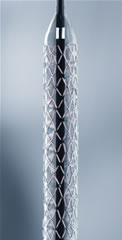 Medtronic's 2nd generation Endeavor drug-eluting stent |
Q: And there may be other factors that may be discovered, such as patient genetic markers, differences in drug-eluting stents, etc. Dr. Kandzari: That's exactly right. It's not even so simplistic to say, "Is 12 months better than 6 months?" or "Is 30 months better than 12 months?" but instead ask, "Is the so-termed optimal duration of DAPT the same for all types of drug-eluting stents?", as we realize that there are emerging differences in outcomes like stent thrombosis among different drug-eluting stents. What is the optimal antiplatelet therapy regimen, given that there are newer agents like Prasugrel available? Also we realize that there are important differences among individuals in their responsiveness to antiplatelet therapy as well. So there are so many emerging complexities that it's no longer such a simple issue as comparing two different timelines of antiplatelet treatment. Q: What do you think are the next big breakthroughs in stenting? Dr. Kandzari: I think, specific to stenting alone, there are really two parallel emerging breakthroughs. The first is the evolution of the drug-eluting stent to stents with bioresorbable polymers, non-polymeric stents and ultimately a bioresorbable stent. I think we're still quite some time away from seeing a bioresorbable stent as part of our routine therapies. |
But on the other hand, I think what is very tangible for us are stents in which there's either no polymer or the polymer fulfills its obligation of delivering the drug and then fades away and takes us back to a bare metal stent. And there are early experiences with the bioresorbable polymers that would suggest great efficacy but theoretically a safety advantage given that a number of recent studies, including one just published on aneurysm formation and stent thrombosis, have implicated at least certain polymers with selected drug-eluting stents as being associated with hypersensitivity.
Then I think in parallel with this, the second issue relates to these ongoing studies of antiplatelet therapy.
If there's a third area about drug-eluting stents, that would be expanding, with the benefits of DES that we’ve realized, expanding DES into complex disease that historically has been considered the domain of cardiac surgery. We've certainly seen the relative benefits and failures of drug-eluting stents compared with surgery in the SYNTAX Trial; what is now in planning at least, and hopeful to be performed, is a randomized trial comparing the use of DES in unprotected left main disease with bypass surgery. In fact I was just at a planning meeting for that this weekend in New York.
Q: We'll certainly look forward to that and other studies that are coming out soon. Thank you for you time.